
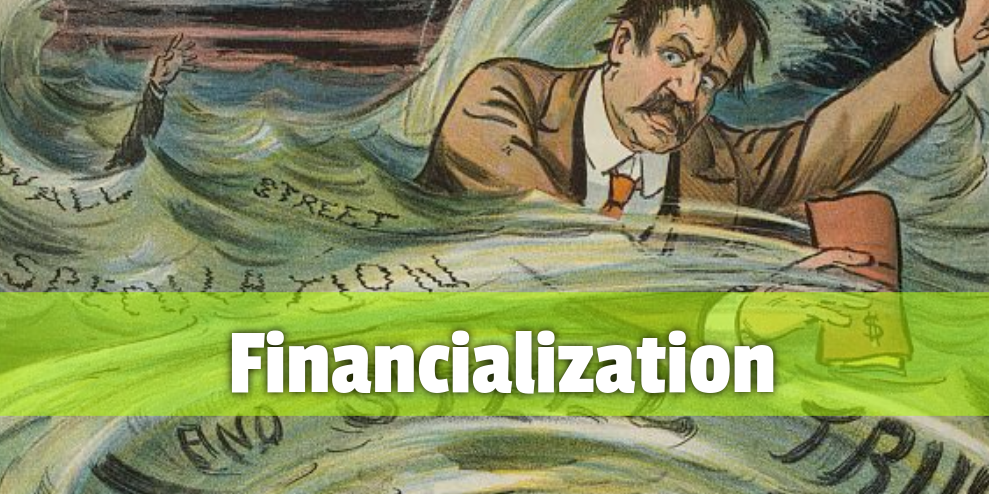
Cyclical metastasis of fictitious capital that multiplies capitalist chaos in the allocation of productive resources, exponentially scales up "financial bubbles" and precedes the bursting of "crashes".
Meaning of financialization
Beyond certain volumes, the development of fictitious capital is not limited to the stock exchanges and the "classic" speculative markets for raw materials. From a certain point onwards, over-accumulated capital, lacking sufficient profitable productive outlets, begins to bet on its own results. This movement does not take the form of classic insurance mechanisms but is part of the creation of "bundles" of assets that offset high speculative risks with the lower risks of investments that have shown relatively stable statistical behavior.
But by betting on its own result, under the appearance of a homogenization and reduction of risks, liabilities (debts) are being converted into assets (shares in funds dedicated to the bet). The apparent reduction in risk mobilizes gigantic masses of capital, raising in the process the average expected return on assets. The bubble begins. The direct consequences form a distinct phenomenon, which is what goes by the name of financialization:
The contrast between speculative returns and the profitability of productive companies (which exploit labor) transforms the latter internally. The objective becomes to raise cash as soon as possible in order to obtain funds to invest. Airlines, travel agencies, bookstores, supermarket chains, etc. etc. will be the first to charge in advance and delay payments to suppliers so as to maximize the time during which they can speculate with their own liquidity.
From a certain point onwards it will become profitable for them to sell at prices below their production cost in order to increase the volume of sales and therefore the volume of cash with which to speculate.
Quite simply, since the expected speculative margins are higher than those from exploitation, the most "rational" thing from the point of view of the individual company's profit is to increase the mass of cash available for as long as possible, even if it generates an operating loss in the core business. This means, for example, cutting shelf times for a supermarket by selling for less than it costs to make a can of preserves or, for a travel agency, selling holidays for less than the cost of the plane's fuel if the purchase is made more than four months in advance.
The problem is that the price structure is corrupted, and with it competition on the capital market and the distribution of capital resources among companies are distorted. Capitalist chaos multiplies in the distribution of resources, and with it the inefficiencies and fragilities of the whole system.
From a certain point onwards, the amount of capital bet on the results of the capital actually used in exploitation exceeds it several times over. Risk multiplies as the material basis of the system becomes smaller and smaller in relation to the bets on its outcome. Meanwhile, incentives lead investors to take more and more risks, even if their indices do not necessarily reflect it. In fact, the main risk is that from a certain point onwards the least risky option is to bet on a general collapse. These are the moments before a generalized financial crash.