
Theoretical position that appeared within the Second International, which held that capitalism had overcome or was overcoming its own contradictions, so that it was imperative to carry out a "revision" of the Marxist foundations, renounce the revolutionary perspective and redefine the socialist parties as democratic parties defending social reforms.
Origins of revisionism
Only two years after Engels' death, Bernstein, one of his literary executors, published in the "Neue Zeit", the theoretical journal of the SPD, a series of articles that would later appear as a book under the title "The Preconditions of Socialism and the Tasks of Social Democracy". It is the first theoretical argument for reformism. Its final conclusion: "The party should present itself as what it is: a democratic party of social reforms".
At first, the party leadership seemed not to take the onslaught seriously. Kautsky, the journal's editor, gave his approval to the publication, but did not bother to put forward a reply either, citing lack of time and of any desire to polemicize. After all, Bernstein was a friend from "the hard years of the anti-socialist laws". In reality, with Marx and Engels dead, theory had lost centrality and weight in the daily life of the party. The real leadership of the movement lay with the parliamentary group, which merged with the party's formal leadership body, and with the trade union bosses.
The role of scientific debates was by then regarded as little more than a cultural programme of the party, a specialised and ultimately useless activity, like a poetry contest which, at best, had the virtue of keeping impetuous young people and intellectuals with political aspirations busy without affecting the rank and file.
If opportunism had replaced consistent theoretical analysis in the setting of the leadership's goals, reformism was its unavowed everyday discourse. The party secretary himself, Auer, an old demagogue who had held the post since 1875 and by then was a happy and well-settled "boss", sent a famous secret letter to Bernstein, which would be made public decades later, reprimanding him in the Jesuitical and cynical manner of the bureaucrats of all times:
My dear Ede, one doesn't formally decide to do the things you suggest, one doesn't say such things, one simply does them.
Ignaz Auer. Private letter to Eduard Bernstein, 1898
So the silent reproach of the old social-democratic leadership to Bernstein was not for "revising" the Marxist programme, as his book claimed to do, but for giving theoretical form to the reality of the reformism that had eaten away at it and whose centre lay in the parliamentary group and the trade union leadership.
The real danger for them lay in a public debate on serious theoretical bases: they did not want to set the mass of party members, the famous rank and file, up as judges, lest they call into question the comfortable atmosphere of class conciliation that increasingly reigned in the institutions of the German state. Nor did any of them see the need to lower the revolutionary flag, as Bernstein proposed. Opportunism made it possible to combine a reformist practice indistinguishable from that of a petty-bourgeois party while still keeping the most conscious part of the class regimented.
The first response would come from a young Polish woman, and therefore a Russian subject, recently taken refuge in Germany and naturalized German, who was then 27 years old: Rosa Luxemburg. It consisted of two articles, the first published in September 1898 in Leipzig, which would be republished as a book in 1900 under the title "Reform or Revolution".
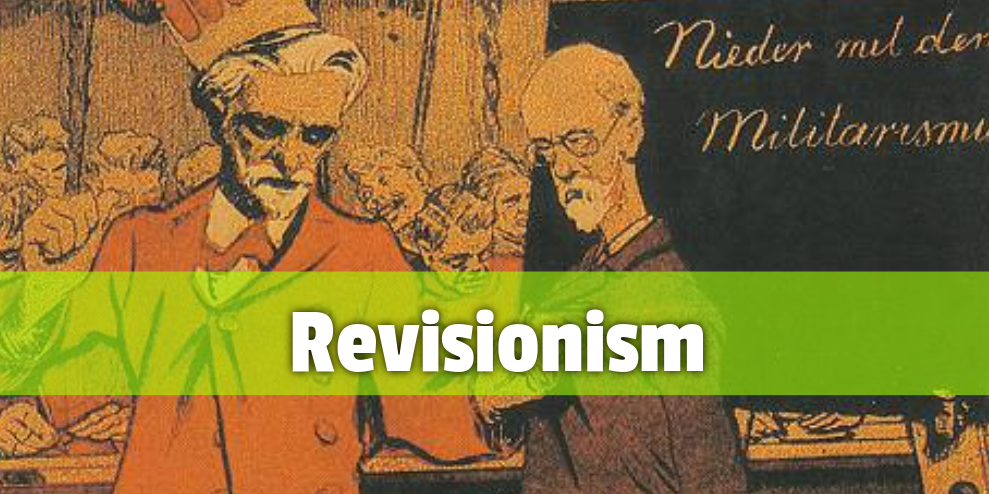
The work became the main theoretical basis of the Left of the Second International, but it did not give way to a sincere debate with consequences: the party bureaucracy closed ranks against Bernstein as a way of not submitting its own opportunism to discussion. The 1899 SPD congress in Hannover opened with a six-hour report by Bebel that turned the four days of debate into a real trial, almost a lynching, of Bernstein, who came close to being expelled. The spectacle of the party's hypocritical public profession of faith was then repeated in the trade unions, with all the social-democratic organizations without exception reaffirming themselves around the class struggle and the perspective of revolution.
The great theoretical and public defeat of Bernstein's revisionism was the great victory of the opportunism of the party and trade union bosses. Like Auer, they all thought, and admitted in private, that in reality the party already was what Bernstein proposed. But accepting it in front of the mass of working-class militants and voters would have deprived them of the powerful image of being hardened revolutionaries restrained only by an exercise of historical responsibility.
In reality they all thought the discussion futile because practically none of them shared the Marxist predictions any longer. They never imagined that they would face a cataclysmic crisis of capitalism, a world war of extermination and still less a world workers' revolution. And yet, when the moment came, when the war broke out and they had to take sides, none of them hesitated for a single instant to close ranks with the bourgeoisie and its state.
Is there revisionism today?
No, for the same reason that there is no reformism: no one believes that the "reforms" proposed by the left of the system lead to socialism... they do not even claim to.