
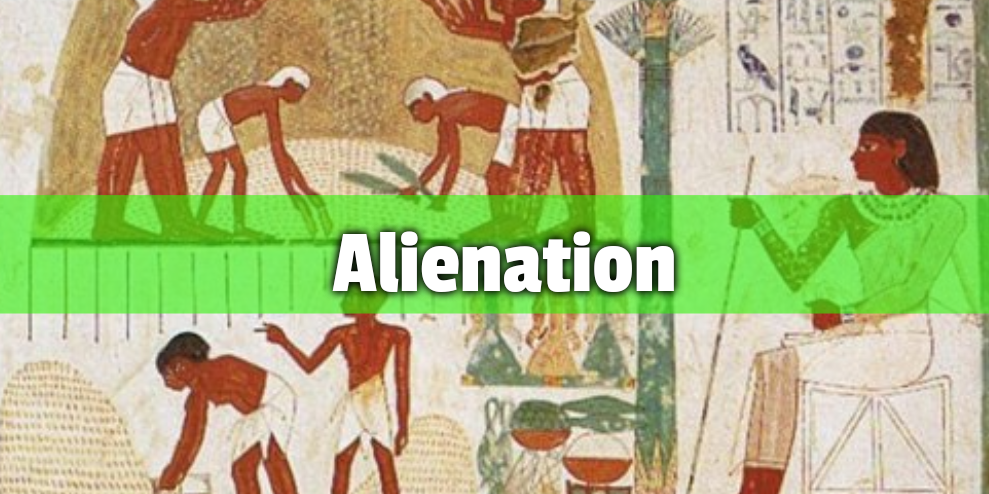
A fracture, due to historically specific social relations, between the self-consciousness of the species and its own needs and nature. Alienation is a product of the division of humanity into classes which makes humanity appear to be opposed to the result of its labor and therefore opposed both to itself and to Nature as a whole.
Origins of alienation
The division of society into classes, which probably occurred some 6,000 years ago, is a recent phenomenon in the life of a species that has been on the planet for 500,000 years and for most of that time lived under a regime of primitive communism based on a hunting, fishing and gathering economy. The communal regime was maintained in the early cities, and it seems that cities organized around forms of primitive communism survived in Europe until as recently as the 4th century BCE.
But the division into classes was inevitable with the development of the productive forces that was taking place with the new technology. It was certainly a leap forward in the progress of the species, but it also meant a profound trauma. The myths of an earlier "Golden Age" have come down to us, scattered through religions and beliefs, which were themselves born to alleviate that painful split of the species, so explosive that a specialized and costly social body, the state, had to appear to keep the social whole minimally cohesive under the new dominant type of productive relations: exploitation.
With the fracture of society into exploited and exploiting classes, there appear the division of labor between personal and social labor, the sexual division of labor and the division between manual and intellectual labor. Private property sets things against the members of the society that produces them, and these members against each other. Town and countryside become opposed. The consciousness of the species is split. From the diffuse animism of primitive communism, which tried to represent the then incomprehensible natural cycles, one passes to theogonies of superior, ordering gods that abstract the vengeful, parasitic and brutal character of the first ruling classes.
With the separation between labor and life, between social community and productive community, life itself breaks apart and flees to the heavens. Beliefs in the "hereafter" begin. The human has become alien to the human; it has "alienated" itself, and alienation defines the new society.
The proletariat as the ultimate expression of alienation
If agrarian regimes were fundamentally based on exaction, on extra-economic exploitation by means of tributes or taxes, capitalism integrates exploitation into the very heart of social relations. As labor is commodified and surplus value is consecrated as the basis of the system of accumulation, exploitation itself becomes invisible, and the division into classes presents itself as "natural".
And at the same time, the contradiction intrinsic to private property - the opposition between producers and product - becomes universal: in a capitalist society crises of "overproduction" are accompanied by the pauperization of great masses of the proletariat. The exploited class is thus universally denied: the very exploitation that defines it is denied, and its own conditions of existence as a class are denied by the contradictions of the system.
This revolution is carried out by the class which society does not consider as such, does not recognize as a class, and which is already in itself the expression of the dissolution of all classes, nationalities, etc., within present society
Marx and Engels. The German Ideology, 1846
It is this total denial that in reality makes it a universal class, because only by raising the banner of generic human needs can it get out of its situation.
In the fully developed proletariat, all humanity, even the appearance of humanity, is abstracted; in the conditions of existence of the proletariat, all the conditions of existence of present society are condensed in their most inhuman form; man has lost himself, but at the same time he has not only acquired a theoretical consciousness of that loss, but has been directly compelled, by misery that is henceforth inescapable, impossible to palliate, absolutely imperative - by the practical expression of necessity - to rebel against that inhumanity; and it is for all this that the proletariat can free itself.
But it cannot free itself without abolishing its own conditions of existence. It cannot abolish its own conditions of existence without abolishing all the inhuman conditions of existence of present society that are condensed in its situation. It is not in vain that it goes through the harsh but strengthening school of labor.
Marx and Engels. The Holy Family, 1844
Communism as the end of alienation
The proletariat, by denying itself as a class through revolution, pushing the whole of society toward communism, is the negation of a negation. It therefore offers the only possible way out for Humanity, its affirmation as such and with it the overcoming of alienation. Communism, a society without division of labor and without class division, "the real beginning of human history," means the end of every division created by the fracture into classes, and therefore the end of social alienation. Marx realizes this very early, in 1844, when he is preparing the notes that will serve as the basis for the core of his work.
Communism as the positive overcoming of private property as man's self-estrangement, and therefore as the real appropriation of the human essence by and for man; therefore as man's return to himself as a social, that is, human, man; a complete, conscious return, accomplished within the whole wealth of human development up to the present.
This communism, as fully developed naturalism, equals humanism, and as fully developed humanism equals naturalism; it is the genuine resolution of the conflict between man and nature, and between man and man, the definitive resolution of the strife between existence and essence, between objectification and self-affirmation, between freedom and necessity, between the individual and the [human] species. It is the riddle of history solved, and it knows itself to be this solution.
Karl Marx. Economic and Philosophical Manuscripts, 1844