
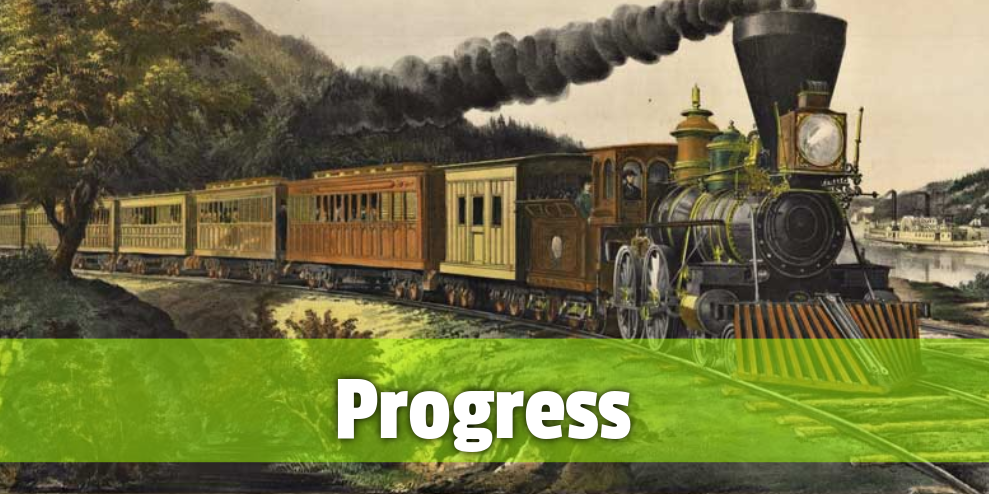
Progress is everything that contributes on a historical level to the development of the productive forces, laying the foundations of the material possibility of overcoming class society through a society of abundance, without classes and therefore without a state, transforming the "economy" into a conscious and collective metabolism between Nature and the human species.
The historical-material character of progress
For historical materialism, progress is not a moral concept, but a material one. Affirming the progressive character of rising capitalism never concealed the fact that:
Capital comes dripping from head to foot, from every pore, with blood and dirt.
Karl Marx, Capital, Chapter XXIV, "The So-Called Primitive Accumulation", 1867
And indeed it is no secret to anyone that the most progressive achievement of rising capitalism, the formation of the world market, took from its very beginnings -the conquest of America-, not to mention the arrival of capitalism in Asia, the form of brutal and oppressive conquest. But that did not stop it from meaning progress for Humanity.
England, it is true, in causing a social revolution in Hindostan, was actuated only by the vilest interests, and was stupid in her manner of enforcing them. But that is not the question. The question is, can mankind fulfil its destiny without a fundamental revolution in the social state of Asia?
If not, whatever may have been the crimes of England she was the unconscious tool of history in bringing about that revolution. Then, whatever bitterness the spectacle of the crumbling of an ancient world may have for our personal feelings, we have the right, in point of history, to exclaim with Goethe:
Should this torture then torment us
Since it brings us greater pleasure?
Were not through the rule of Timur
Souls devoured without measure?Karl Marx. The British Rule in India, 1853
In the same way, phenomena such as national liberation, which generally had a progressive meaning in rising capitalism, have a reactionary meaning in the decadence of capitalism, just as the emergence and defense of common lands, which had a progressive meaning during long periods of the feudal regime, became a brake on the development of the productive forces at the dawn of capitalism.
Is the concept of progress "teleological"?
A common criticism of the idea of progress from the anarchizing petty bourgeoisie has been that the materialists "told history backwards", "in a religious way", presenting it as a permanent and necessary ascent. It is true that if we look at the history of humanity as a whole, there has been a prodigious development of the productive forces and capacities of the species.
But the general phenomenon cannot deny that historical necessity has not always been realized. Revolutionary classes have failed more than once, and the phases of decadence of the societies in which they developed have ended, in those cases, in the collapse of the social whole and the "common ruin of the contending classes".
Freeman and slave, patrician and plebeian, lord and serf, guild-master and journeyman, in a word, oppressor and oppressed, stood in constant opposition to one another, carried on an uninterrupted, now hidden, now open fight, a fight that each time ended, either in a revolutionary reconstitution of society at large, or in the common ruin of the contending classes.
Karl Marx and Frederick Engels. Manifesto of the Communist Party, 1848
Today it is in fact impossible to speak of "real" progress in the midst of a capitalism in decadence in which economic growth has become dissociated from human development. All its cultural and ideological forms ooze reaction from every pore. The perennial crisis, the degradation of human relations, of culture and even of food, the continuous drive towards war and practically every facet of daily life under the system make it clear that only that which is effectively and unambiguously oriented towards overcoming capitalism can be considered progressive.