
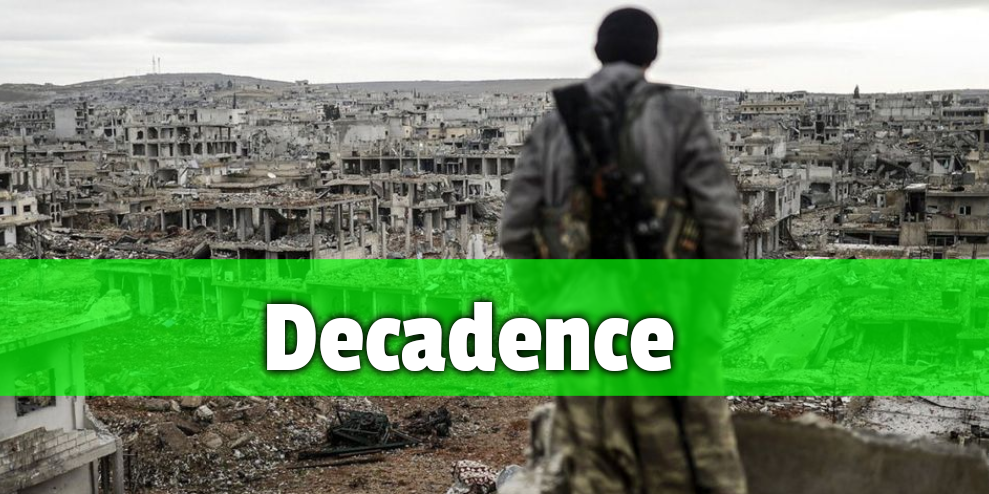
A mode of production enters a phase of historical decadence when the relations of production that characterize it cease to be forms of development of the productive forces and become obstacles to the free development of those same forces. Consequently, development and economic growth become dissociated.
The bases of the decadence of capitalism
From the Manifesto of 1848 itself, the communist movement was clear that the expansive tendency of capitalism would reach an objective limit and that by that time the working class would already be a practically universal social and productive force.
The development of Modern Industry, therefore, cuts from under its feet the very foundation on which the bourgeoisie produces and appropriates products. What the bourgeoisie therefore produces, above all, are its own grave-diggers. Its fall and the victory of the proletariat are equally inevitable.
But what were the objective limits of the progressive development of capitalism? When would the system enter decadence, making its overcoming an immediate program for the workers? To find out, Marx began an investigation lasting years, which would remain largely unfinished, but which uncovers the essentials beneath the ideological cloud of bourgeois Economic Theory: "Capital".
His first discovery is that capitalism is a commodity system, centered on the production of commodities. Not every product is a commodity; the commodity is produced not to be consumed but to be sold, and therefore presupposes private property. There are, however, various commodity economies different from capitalism. What defines capitalism is a new social relationship: the capital-labor relationship.
Labor, labor power in fact, is in capitalism just one more commodity. A commodity that has a market price, the wage. And that has a unique property: it generates the increase in value of products over the cost of their components, including labor (whose cost is the wage). It is that increase in value (surplus value) which, when realized (when the commodity is sold at a price higher than that of its components added together), produces profit, gain... a profit that is accumulated in a new form: capital.
Capital that in turn will have to be "made profitable" by applying it (investing it) in new cycles of production that generate new surplus value and therefore new profits, swelling capital once again.
Marx then studies the dynamics of the evolution of capital under the assumption of an ideal 100% capitalist economy, where there is only one capitalist and production is sold in its entirety. This makes it possible to unmask the origin of the growth of value in unpaid labor without having to go into the analysis of the capital market and of how profit is shared out among the capitalists.
In the model of the first book of "Capital", surplus value and profit are equal because there is only one company. This reduction also allows him to isolate the most important tendencies, among them the tendency of the rate of profit to fall, which entails the increase in the mass of products manufactured and in the relative weight of dead labor (capital invested in machines, buildings, etc.) over living labor (labor performed by people, bought by the capitalist).
All this is extremely important because it explains how and why, by its own internal logic, capitalism pushes humanity, brings it closer, towards abundance, developing its productive capacities and knowledge amid the convulsions and miseries proper to a system that in each cycle tends to pauperize more and more workers, until it reaches the absurdity of capitalist overproduction in times of crisis.
But this does not deny that Marx is fully aware that between one crisis and the next there is something more, and that this something more is precisely related to the non-capitalist sector of the world commodity economy: all those independent peasants who do not exploit workers, the artisans, etc., who produce commodities without producing surplus value. The productive sectors that had been the majority until the arrival of capitalism, and on which capitalism feeds parasitically.
Why does it feed on them? Because, since surplus value is unpaid labor, by definition the workers cannot pay for the whole of production. Giving them credit to do so only postpones the problem. If the bourgeoisie itself "consumed" the total surplus value produced, the accumulation of capital would become impossible. Nor could surpluses be moved from more capitalized sectors to others except at the cost of destroying capital.
Because of the "restricted bases" of the capitalist sector there can only be "overproduction", that is, wages are not enough to buy everything produced... capitalism needs to expand from the very first moment. First towards its internal non-capitalist markets. Second towards external ones. That was the material driving force of the worldwide expansion of capitalism.
Since the aim of capital is not the satisfaction of needs but the production of profit, and since it achieves this aim only by methods that regulate the volume of production according to the scale of production, and not the other way round, there must constantly be a rift between the restricted dimensions of consumption on a capitalist basis and a production that constantly tends to overcome this barrier immanent to it.
Moreover, capital consists of commodities, and therefore the overproduction of capital implies the overproduction of commodities. Hence the curious phenomenon that the same economists who deny the overproduction of commodities admit that of capital.
If it is said that within the various branches of production there is not a general overproduction but a disproportion, this means nothing other than that, within capitalist production, proportionality between the various branches of production is established as a constant process out of disproportionality, because here the interconnection of production as a whole imposes itself on the agents of production as a blind law, and not as a law grasped by their associated intellect and thereby brought under their collective control.
Furthermore, in this way it is demanded that countries in which the capitalist mode of production is not developed should consume and produce to a degree suited to the countries of the capitalist mode of production.
If it is said that overproduction is only relative, this is quite correct; but the whole capitalist mode of production is only a relative mode of production, whose limits are not absolute, but are absolute for it, on its own basis. How else could there be a lack of demand for the very commodities that the mass of the people lack, and how would it be possible to have to seek this demand abroad, in more distant markets, in order to be able to pay the workers at home the average of the indispensable means of subsistence?
Because only in this specific, capitalist context does the surplus product acquire a form in which its owner can make it available for consumption only insofar as it is reconverted into capital for him. Finally, if it is said that in the last instance the capitalists only have to exchange their commodities among themselves and eat them up, the whole character of capitalist production is forgotten, and so is the fact that what is at stake is the valorization of capital, not its consumption.
In short, all the objections to the palpable manifestations of overproduction (manifestations that pay no heed to such objections) amount to saying that the limits of capitalist production are not limits of production in general, and therefore not limits of this specific mode of production, the capitalist one either.
But the contradiction of this capitalist mode of production lies precisely in its tendency towards the absolute development of the productive forces, which comes permanently into conflict with the specific conditions of production within which capital moves, and which are the only ones within which it can move.
Karl Marx. Chapter XV of Book III of "Capital", 1894.
It follows that there is a limit to the progressive development of capitalism, a frontier beyond which we can say that the system has entered decadence. As in all previous modes of production, there comes a moment from which the relations of production...
From forms of development of the productive forces these relations turn into their fetters. Then begins an era of social revolution.
Karl Marx. Preface to "A Contribution to the Critique of Political Economy", January 1859
Imperialism and decadence
The chronic lack of markets of capitalism could only lead it to reach that limit and give way to decadence. A moment that would express itself "in winds of catastrophe" of war.
The existence of non-capitalist buyers of surplus value is a direct vital condition for capital and its accumulation. In this sense such buyers are the decisive element in the problem of the accumulation of capital. But one way or another, in fact, the accumulation of capital as a historical process depends in many respects on non-capitalist social strata and forms. (...) Capitalism needs, for its existence and development, to be surrounded by non-capitalist forms of production. (...) The second fundamental precondition, both for the acquisition of means of production and for the realization of surplus value, is the extension of the action of capitalism to societies with a natural economy. (...)
Imperialism is the political expression of the process of accumulation of capital in its struggle to conquer the non-capitalist environments that are not yet exhausted. Geographically, these environments still cover today the widest territories of the Earth.
But compared with the powerful mass of capital already accumulated in the old capitalist countries, which struggles to find markets for its surplus product and possibilities of capitalization for its surplus value; compared with the speed with which territories belonging to pre-capitalist cultures are today being turned into capitalist ones, or in other words: compared with the high degree of the productive forces of capital, the field still seems small for its expansion. This determines the international game of capital on the world stage.
Given the great development and the increasingly violent competition among the capitalist countries to conquer non-capitalist territories, imperialism increases its aggressiveness against the non-capitalist world, sharpening the contradictions between the contending capitalist countries. But the more violently and energetically capitalism brings about the total collapse of non-capitalist civilizations, the more rapidly it will cut the ground from under the accumulation of capital.
Imperialism is as much a historical method for prolonging the existence of capital as a sure means of objectively putting an end to its existence. This is not to say that this end must be cheerfully reached. The very tendency of capitalist development towards it already manifests itself in winds of catastrophe.
Rosa Luxemburg. "The Accumulation of Capital", 1913.
The catastrophe that would certify the system's entry into decadence came in the form of a world war that also opened the era of proletarian revolutions.
Capitalism is the first economic form with the capacity for worldwide development. A form that tends to spread over the whole surface of the Earth and to eliminate all other economic forms; that tolerates the coexistence of no other.
But it is also the first that cannot exist alone, without other economic forms to feed on, and which, at the same time as it tends to become the only form, fails because of the internal incapacity of its development. It is a living historical contradiction in itself. Its movement of accumulation is the expression, the constant resolution and, at the same time, the intensification of the contradiction.
At a certain stage of development, this contradiction can only be resolved by the application of the principles of socialism; of that economic form which is at the same time, by its very nature, a world form and a harmonious system, because it will be directed not towards accumulation but towards the satisfaction of the vital needs of working humanity itself and towards the expansion of all the productive forces of the planet.
Rosa Luxemburg. "The Accumulation of Capital", 1913.
Imperialist world war and decadence
The symptom that capitalism could no longer expand without cataclysmic consequences was an unprecedented phenomenon, an imperialist war that was also a world war because the expansion of the system was already worldwide. It is the moment when the contradictions expressed by imperialism become evident and unsolvable on a world scale. The moment when it can be said that capitalism, as a whole, has entered decadence.
Friedrich Engels once said: "Capitalist society faces a dilemma: advance to socialism or regression into barbarism". What does "regression into barbarism" mean at the present stage of European civilization?
We have read and quoted these words lightly, without being able to conceive their terrible meaning. At this moment it is enough to look around us to understand what regression into barbarism means in capitalist society. This world war is a regression into barbarism. The triumph of imperialism leads to the destruction of culture, sporadically during a modern war, and forever if the period of world wars that has just begun is allowed to run its damnable course to its final consequences.
Thus we stand today, just as Engels prophesied a generation ago, before the terrible choice: either imperialism triumphs and brings about the destruction of all culture and, as in ancient Rome, depopulation, desolation, degeneration, an immense cemetery; or socialism triumphs, that is, the conscious struggle of the international proletariat against imperialism, its methods, its wars.
This is the dilemma of world history, its iron alternative, its scales trembling at the point of balance, awaiting the decision of the proletariat. On it depends the future of culture and of humanity. In this war imperialism has triumphed. Its brutal, murderous sword has tipped the scales, with overwhelming brutality, down into the depths of the abyss of shame and misery. If the proletariat learns from this war and in this war to exert itself, to shake off the yoke of the ruling classes, to become master of its own destiny, the shame and misery will not have been in vain.
Rosa Luxemburg. The Crisis of German Social Democracy, 1915.
Does decadence mean permanent crisis?
As we have seen, the tendency to crisis is present in the very logic of the accumulation of capital. Once the periods of reconstruction that follow the great generalized imperialist wars are over, the tendency to crisis acts in a sustained and permanent way in decadence.
But a tendency does not mean that accumulation ceases or that capital devalues itself, or even that production continuously declines. What is transformed is the meaning of accumulation, and what emerges is the inability of the decadent system to develop its main productive force: the proletariat.
Contrary to what the majority of today's revolutionary vanguard believes (and by that I mean only those groups and individuals who point to counter-revolution and state capitalism in Russia), not all development of the instruments of production is positive, however much it may show rising indices of commodities, turn out engineers and increase the number of workers.
It is time to put an end to a materialism of such a simple-minded kind, the begetter of theoretical blunders and proletarian defeats. To be progressive, the development of the means of production must be accompanied by an increase in the consumption of the laboring population, in its culture and its freedom. The bourgeoisie itself achieved this in a relatively straight line up to the moment of its decisive crisis.
G. Munis. The Ancient China of Mao Tse-tung, 1959
The result is, first of all, a permanent crisis as a civilization, as a mode of production capable of generating human development. In decadence, in fact, and this is decisive, "economic" development, that is, the advances of capital accumulation, are increasingly at odds with human development.
A society or type of civilization is developing as long as the structural and superstructural factors contained in its original impulse go on expanding and spreading, those that constituted its reason for being, its historical necessity, its human justification. Because a type of civilization -that is to say, a class- has never been formed and raised to the rank of ruling class except as a positive representation, however incomplete, of all classes, even those that bear the worst lot. Its system must grant everyone a better material, cultural and moral condition, even a shred of freedom, relative to the previous situation. That content is the only thing that can be called social development.
We saw this very clearly during the rise of capitalist society. More than any other civilization since the appearance of classes and the State, it increased general culture, political freedom, nutritional possibilities and everything that concerns the production and reproduction of human life, not to mention the multitude of good consequences those three factors brought with them. The greater mastery of Nature characteristic of capitalist civilization, even though it was mainly by and for the bourgeoisie, had more or less of an effect on the poor and exploited classes.
The same can no longer be said of present-day capitalism. Its mastery of Nature, from physics and chemistry to genetics and psychoanalysis, keeps increasing. But in general it only results in worse conditions for the great mass of the poor classes.
Metals are manufactured today so resistant that they allow space capsules to pass through the dense layers of the atmosphere, but, from the saucepan to the automobile, the products offered on the market are of a poor quality calculated to force their early replacement; we know how to make fabrics that would last more than a lifetime, but the suits or stockings sold by the tens or hundreds of millions are made to turn soon into rags; we know how to produce food of the highest quality and purity, but it has become impossible to find, a delicacy for potentates, for the great mass, starting with simple bread;
adulterated products, when not toxic ones, wrapped in plastics that alter their chemical composition; we know how to select the best-yielding animal species for the butcher's and the stable, but steak, chicken, pork, etc. contain the hormones with which the animals have been artificially fattened, while milk is a watery brew depleted of the substances most indispensable to child nutrition; we can build residential buildings more resistant than a cathedral, but the house or apartment of the ordinary man falls into ruin before it has been paid off.
An inseparable complement of the above, radio and television, extremely powerful instruments of information and cultural education, deliberately deceive and brutalize billions of people on every continent, always seconded by the daily press; in the technical schools and universities, youth is channeled and shaped according to state-capitalist plans, while the quality of teaching degrades year after year; psychoanalysis itself serves, in factories, guidance centers, advertising agencies and police departments, repugnant operations that debase the individual and collective mind.
There would be no end to listing all the respects in which capitalism (more precisely, so that the reader does not exclude any country: the society based on wage labor) is perverting everyday life, corrupting everything it itself created. The quick sketch above must nevertheless be completed by pointing out two even more serious aspects.
The first is the present condition of the working class, a slave to work and to sleep, with no time for leisure in this age of automation, without any freedom in the factory, disciplined as in a barracks and watched over by the trio of capital, trade unions and State, which moreover subject it to piecework, the vilest form of exploitation; forced, in order to avoid destitution, to subject the wife as well as the husband to the whirlwind of that same exploitation; deprived of a trade by fragmented work [= precarious work, Ed.]; always at the mercy of dirigiste planning; ever more dispossessed relative to what it produces and to the total amount of wealth usurped by capital.
Never have the instruments of its labor and the products of its labor been so alien and oppressive to it. The very automobile in which many workers drive ties several more knots in the bonds that hold them captive, miseries that have turned the whole of society into a concentration camp plundered daily by its organizers, by way of commerce and the tax authorities.
The second and more conclusive of the two aspects mentioned is political totalitarianism, at once police and militarist, which has been invading the whole world, including the countries where a worm-eaten bourgeois democracy survives.
By itself, the ever more overwhelming weight of armies, war production and police represents a degenerative factor of the first order in present-day civilization. It is not only a question of the expenditure, a total loss, that their existence entails, far greater than what the official budgets state, which is already enormous; nor of the useless, parasitic, harmful or criminal labor assigned to tens of millions of people; the worst of all is the function that the war industries and the military and police activities have acquired, without distinction of blocs or political regimes.
Indeed, if the industrialization fostered by capitalism was never for consumption except through the sale of commodities and bourgeois enrichment, with the enormous volume of war production -not to mention that of shoddy goods- it becomes industrialization for industrialization's sake, whose relationship with necessary consumption is ever more tenuous and false.
And for their part, police and armies embody power for power's sake of an anonymous capital, overtaken by technology and by human needs, which outlives itself as a form of social organization. In ancient Egypt there came a time when the cult of death consumed more than half of the population's labor. In present-day capitalism it is not a cult, but an industrial and physical practice of death that approaches the same balance and is already capable of murdering the entire human species in a few minutes.
G. Munis. The Impossibility of Capitalist Development, 1972
This contradiction between the development of capital and human development -the canonical definition of decadence- is expressed in the tension towards everything that prepares war in the everyday life of decadent capitalism: a malformed "growth" in times of prosperity, with a monstrous development of the state and the bureaucracy, state capitalism, which responds to the growing structural difficulty of keeping cohesive a society organized around a civilization that tends to decompose under the forces it has itself created.
For more than forty years capitalism, its progressive stage completed, has run counter to humanity's needs for economic and political freedom.
Great imperialist slaughters, lesser wars, military, Stalinist and fascist dictatorships, the shrinking and corruption of freedom in the old countries of bourgeois democracy, intensified exploitation of the proletariat, lengthening of the working day, reintroduction of piecework, monstrous growth of state and private bureaucracy, of foremen, supervisors and timekeepers in industry, of the police, standing armies and war production, conversion of the trade unions into regulators of exploitation: all manifestations of the reactionary corruption of capitalism, whether one considers any country in isolation or all of them together, the backward as well as the advanced, Eastern and Western blocs alike.
Capitalism is destroying civilization and degrading man. The most glaring sign of this degradation is that Moscow and Washington can annihilate the whole of humanity with a single gesture, while trying to make the world believe that the Russian armies are preferable to the American ones, or the American to the Russian. The atomic threat alone would more than justify an uprising that would do away, at the same time as with the nuclear bombs, with the whole war apparatus and the economic system that needs them.
G. Munis. Appeal and exhortation to the new generation, 1966