
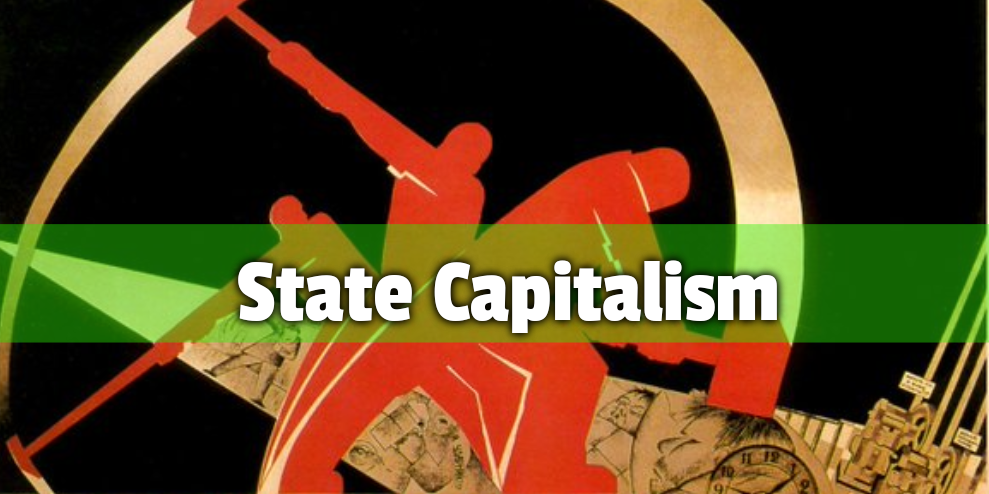
The form that the organization of capital takes in decadent capitalism. It materializes the concentration of finance capital - the union of banking and industrial capital - and the monopolies within and around the state. Socially it promotes the integration of the remnants of the former exploiting classes with the bourgeoisie and the state bureaucracy, and politically it rests on the end of civil society and the integration of broad layers of the petty bourgeoisie as middle cadres in the state apparatus and big business.
Origin of state capitalism
It is not that the bourgeoisie has no fatherland. It is that the "fatherland", the national state, is theirs; it is they themselves, organized against the rest of society.
Imperialism will already drive a reorganization of the bourgeoisie. Little by little, capitalist competition is replaced by small groups of large companies born of mergers and gigantic concentrations of capital. These companies, until then the owners of the banks, become the property of the banks. And they all become intertwined with the state in what is nothing but a form of socialization, that is, the organized orientation of all of society towards a single objective: the accumulation of capital. This socialization also meant a "socialization of the concept of capitalist" through, initially, the joint-stock company and the emergence of a "managerial" bourgeoisie.
The triumph of the descending tendency will not necessarily appear as an absolute numerical decrease in medium-sized enterprises. It must appear, first, as a progressive increase in the minimum capital indispensable for the functioning of enterprises in the old branches of production; and second, in the constant shortening of the interval of time during which small capitalists have the opportunity to exploit the new branches of production.
The result, as far as the small capitalist is concerned, is an ever shorter duration of his stay in the new industry and an ever faster change in the methods of production as a field for investment. For the middle capitalist strata as a whole there is an ever faster process of social assimilation and dissimilation. [...]
What, in the last analysis, does the economic phenomenon of the joint-stock company mean? It represents, on the one hand, the unification of a number of small fortunes into one large capital for production. It represents, on the other hand, the separation of production from capitalist ownership. That is, it denotes that a double victory has been won over the capitalist mode of production: but still on capitalist foundations.
What, then, do the statistics cited by Bernstein, according to which a growing number of shareholders participate in capitalist enterprises, mean? The statistics demonstrate precisely this: today a capitalist enterprise does not correspond, as before, to a single owner of capital but to a series of capitalists.
Consequently, the economic notion of "capitalist" no longer corresponds to an isolated individual. The industrial capitalist of today is a collective person, composed of hundreds, even thousands of individuals. The category of "capitalist" has become a social category. It has been "socialized", within the framework of capitalist society.
Rosa Luxemburg. Reform or Revolution, 1899
This process, which starts in the early stages of imperialism and becomes generalized and radicalized throughout capitalist decadence, changes the structure and composition of the bourgeoisie: the boundaries between the old landowning classes, the captains of industry, the bankers and the high state bureaucracy will become blurred. A good part of the bourgeoisie will cease to hold the legal ownership of a large industry and will instead become shareholders in financial consortia.
Others not even that. In a good part of the new states that came out of national liberation during decadence, starting with Turkey, the first country to achieve it in the imperialist epoch, the new national bourgeoisie will be made up mainly of military officers, high bureaucrats, managers, bankers and leaders of the very political apparatus of the new state... from which they will generate business bourgeoisies.
The incomes that sustain and incentivize the contemporary bourgeoisie all over the world have in many cases lost the direct relation to a concrete part of production that they had when the bourgeoisie was made up of individual factory owners. The ways of distributing income within the ruling class are by now so diverse and imaginative that they are sometimes classified simply as "corruption".
Although it may seem remote today, it is something very similar to what the Spanish ruling class experienced during the 1914 war or, a little later, the Argentine ruling class, the matrix of today's state capitalism, in which the state bourgeoisie is described as an amalgam of "castes", "oligarchs", "apparatchiks" and "power networks".
This transformation of competition into monopoly is one of the most important, if not the most important, phenomena of the economy of capitalism in recent times. (…)
(…) Competition becomes monopoly. The result is a gigantic progress in the socialization of production. In particular, the process of technical invention and improvement is also socialized.
This has nothing to do with the old free competition of scattered employers who did not know each other and who produced for an unknown market. Concentration has reached such a point that an approximate inventory can be made of all the sources of raw materials (for example, iron ore deposits) of a country and even, as we shall see, of several countries and of the whole world. Not only is this calculation made, but gigantic monopolist associations seize those sources.
An approximate calculation is made of the capacity of the market, which the associations mentioned "share out" among themselves by contract. Skilled labor is monopolized, the best engineers are hired, and the means of transport and communication - the railways in America and the shipping companies in Europe and America - fall into the hands of the monopolists.
Capitalism, in its imperialist stage, leads directly to the socialization of production in its most varied aspects; it drags the capitalists, so to speak, against their will and their consciousness, into a certain new social order, a transitional one from absolute freedom of competition to complete socialization. (…)
We are no longer dealing with a competitive struggle between large and small enterprises, between technically backward and technically advanced establishments. We are faced with the strangling by the monopolists of all those who do not submit to the monopoly, to its yoke, to its arbitrariness. (…)
The development of capitalism has reached a point where, although commodity production still "reigns" as before and is regarded as the basis of the whole economy, in reality it has already been undermined, and the main profits go to the "geniuses" of financial manipulation. These manipulations and swindles are rooted in the socialization of production; but the immense progress of humanity, which has achieved this socialization, benefits... the speculators. Later on we shall see how, "on this basis", the petty-bourgeois and reactionary critique of capitalist imperialism dreams of going back to "free", "peaceful" and "honest" competition. (…)
The suppression of crises by the cartels is a fable of bourgeois economists, who spare no effort to embellish capitalism. On the contrary, the monopoly created in certain branches of industry increases and aggravates the chaos inherent in capitalist production as a whole. (…)
The scattered capitalists come to form one collective capitalist. When it keeps a current account for several capitalists, the bank apparently performs a purely technical, merely auxiliary operation.
But when this operation grows to gigantic proportions, it turns out that a handful of monopolists subordinate the commercial and industrial operations of the whole of capitalist society, putting themselves in a position - through their banking relations, current accounts and other financial operations - first, to know exactly the situation of the various capitalists, then to control them, to influence them by widening or restricting credit, facilitating it or hindering it, and finally to decide their fate entirely, to determine their profitability, to deprive them of capital or to allow them to increase it rapidly and in immense proportions, etc. (…)
At the same time there develops, so to speak, a personal union of the banks with the largest industrial and commercial enterprises, the merging of the one with the other through the ownership of shares, through the appointment of bank directors to the supervisory boards (or boards of directors) of industrial and commercial enterprises, and vice versa. (…)
The "personal union" of the banks and industry is completed by the "personal union" of both with the government. "Seats on the supervisory boards," writes Jeidels, "are voluntarily entrusted to well-known personalities, as well as to former state officials, who can facilitate relations with the authorities to a considerable degree (!!)." (…)
The result is, on the one hand, an ever-growing merger, or, in N.I. Bukharin's apt expression, coalescence of bank and industrial capital and, on the other, the transformation of the banks into institutions of a truly "universal character". (…)
In commercial and industrial circles one often hears complaints about the "terrorism" of the banks (…) At bottom, these are the same complaints of small capital about the yoke of big capital, only in this case the category of "small" capital is made up of a whole consortium! The old struggle between small and big capital is being reproduced at a new and immeasurably higher stage of development. (…)
Concentration of production; the monopolies arising from it; the merging or coalescence of the banks with industry: such is the history of the rise of finance capital and such is the content of that concept. (…)
The management of capitalist monopolies inevitably becomes, under the general conditions of commodity production and private property, the domination of a financial oligarchy (…) [While] the apologists of imperialism and finance capital do not expose but conceal and embellish the mechanism of the formation of the oligarchies, their methods, the size of their "licit and illicit" incomes, their relations with parliaments, etc., etc.
Lenin. Imperialism, the Highest Stage of Capitalism, 1916
Stalinism and state capitalism
State capitalism is a general phenomenon in all states throughout the whole period of capitalist decadence. In Russia first and in its satellites later, however, it took on a particular and characteristic form. The counter-revolution in Russia had ridden precisely on these tendencies, embodying itself in the managerial layer of a state capitalism which, as a result of isolation and civil war, was no longer counterbalanced by the political power of the organized workers.
This managerial layer would capture the state and the Bolshevik party with a program of defense of the national capital it represented and of subordination of class objectives to it. Its formula of "socialism in one country", first put forward in 1924 and imposed as a dogma of faith in 1928, meant nothing other than the subordination of the interests of the world revolution to the national capital that the post-revolutionary state had laboriously concentrated.
When it finally seizes all power in 1928, it will give free rein to all the tendencies generated by that national capital. Tendencies that were the same as those of any other national capital in capitalist decadence: imperialism, nationalism, militarism, pauperization of the working masses...
There is an important difference, however. The new Russian bourgeoisie did not emerge organically from the transformation of business ownership driven by finance capital. It was born of the state itself.
And it was not just any state: it was the state that had been formed to defend the revolution during the civil war. It was therefore a bourgeoisie that justified itself politically as the continuation of the October revolution and that would consequently try by every means to sell its particular form of state capitalism as socialism. What is more, its origin would bind it together around the capture and domination of the party of the revolution, which it would completely remake in its own image and likeness, preserving only its outward symbols and massacring the generation of revolutionaries who had been the protagonists of October.
State capitalism and totalitarianism
The totalitarian tendency is a direct consequence of the concentration of state and capital. During the counter-revolution, the state tries to absorb the whole of bourgeois "civil society" and to destroy or subordinate the spaces of "workers' democracy" created during rising capitalism by the Second International. This is the central objective of the rise of fascism.
Fascism is not merely a system of repression, violence and police terror. Fascism is a particular system of the state based on the extirpation of all the elements of proletarian democracy in bourgeois society. The task of fascism is not only to destroy the communist vanguard, but also to keep the whole class in a state of forced atomization.
For this it is not enough to physically exterminate the most revolutionary layer of the workers. All free and independent organizations must be crushed, all the bases of support of the proletariat destroyed, and the results of three quarters of a century of work by social democracy and the trade unions annihilated. For it is on this work that, in the last analysis, the communist party rests.
Leon Trotsky, "The Turn of the Communist International and the Situation in Germany", 26 September 1930
Exactly the same will be done by the Stalinist counter-revolution, first in Russia and then in the countries integrated into its imperialist bloc after the Second World War. The whole fabric of workers' socialization will be destroyed root and branch and replaced, as in the fascist states, by parodies dependent on the ministries and watched from within by the terrorist apparatus of the state.
What is more, in the European democracies, the Socialist and Communist parties will be fundamental in producing a "democratic" version with similar results. Not only the trade unions, which had followed a path of integration into the state on their own since the beginning of the imperialist epoch, but also cultural associations, cooperatives, neighborhood groups... will be taken over, controlled and integrated into formal state bodies on which they will end up depending ideologically and financially.
The state's voracity will not stop at the organizations that brought workers together. The political expressions of particular factions of capital and of the petty bourgeoisie - parties, associations, research centers... - everything that liberal democracy had articulated within a framework that emulated the market, representing the competition/conflict of interests and ideas, came to be defined by the new functions of the state. They became more or less autonomous organs of the state.
The analogy of state capitalism is no longer the "perfect competition" between parties and interests whose aggregation lies beyond their powers, but the "table" at which the great monopolies "plan" and "make pacts". As a consequence, "social groups" - trade unions, employers' organizations, etc. - cease to be expressions of the different fractions of society before the state and become expressions of the state before the different layers of society. This is particularly clear in the case of the trade unions, treated as monopolists of labor power on the model of the energy companies or heavy industry.
But it is identical in territorial administration. For example, until then the difference between an elected official and a governor or government delegate was that the former represented the citizens before the state and the latter represented the state before the elected officials. Under state capitalism, elected officials become representatives of the state in the territory, and this responsibility is required of them even by law. Only in moments of acute political crisis will the "systemic" social fabric be called into question again, if not redirected by a petty bourgeoisie in revolt.
But this does not negate - quite the contrary - the main tendency: state capitalism consciously seeks to instrumentalize and occupy the whole political and social space, integrating expressions of discontent whenever it can and silencing and repressing them when it cannot. This can be seen clearly in the space of "opinion", where the "pluralism" that once represented the difference of interests and the subjects of political conflict now serves, above all, to affirm "in diversity" the consensus of power around the management of the system.