
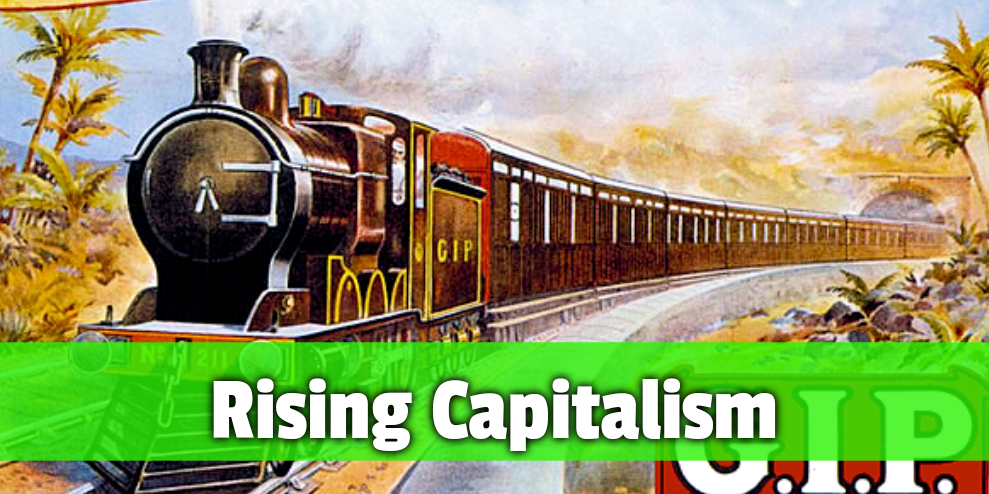
Historical period during which the capitalist relations of production served the free development of the productive forces of Humanity. This is the period in which the world market and the global systems of communications and transport were born, the productivity of almost all factors multiplied, the global population grew as never before, and a universal class appeared: the proletariat.
Rising capitalism and progress
Capitalism was, for a long period, a progressive system. Progressive not in the false moral sense of "humanitarian" or egalitarian, far from it, but because it revolutionized the whole world, developing the productive forces of humanity as never before by commodifying social relations and creating a universal class, the proletariat.
The bourgeoisie, historically, has played a most revolutionary part.
The bourgeoisie, wherever it has got the upper hand, has put an end to all feudal, patriarchal, idyllic relations. It has pitilessly torn asunder the motley feudal ties that bound man to his "natural superiors", and has left remaining no other nexus between man and man than naked self-interest, than callous "cash payment".
It has drowned the most heavenly ecstasies of religious fervour, of chivalrous enthusiasm, of philistine sentimentalism, in the icy water of egotistical calculation. It has resolved personal worth into exchange value, and in place of the numberless indefeasible chartered freedoms, has set up that single, unconscionable freedom — Free Trade. In one word, for exploitation, veiled by religious and political illusions, it has substituted naked, shameless, direct, brutal exploitation.
The bourgeoisie has stripped of its halo every occupation hitherto honoured and looked up to with reverent awe. It has converted the physician, the lawyer, the priest, the poet, the man of science, into its paid wage labourers.
The bourgeoisie has torn away from the family its sentimental veil, and has reduced the family relation to a mere money relation.
The bourgeoisie has disclosed how it came to pass that the brutal display of vigour in the Middle Ages, which reactionaries so much admire, found its fitting complement in the most slothful indolence. It has been the first to show what man's activity can bring about. It has accomplished wonders far surpassing Egyptian pyramids, Roman aqueducts, and Gothic cathedrals; it has conducted expeditions that put in the shade all former Exoduses of nations and crusades.
The bourgeoisie cannot exist without constantly revolutionising the instruments of production, and thereby the relations of production, and with them the whole relations of society. Conservation of the old modes of production in unaltered form, was, on the contrary, the first condition of existence for all earlier industrial classes.
Constant revolutionising of production, uninterrupted disturbance of all social conditions, everlasting uncertainty and agitation distinguish the bourgeois epoch from all earlier ones. All fixed, fast-frozen relations, with their train of ancient and venerable prejudices and opinions, are swept away, all new-formed ones become antiquated before they can ossify. All that is solid melts into air, all that is holy is profaned, and man is at last compelled to face with sober senses his real conditions of life, and his relations with his kind.
The need of a constantly expanding market for its products chases the bourgeoisie over the entire surface of the globe. It must nestle everywhere, settle everywhere, establish connexions everywhere.
The bourgeoisie has through its exploitation of the world market given a cosmopolitan character to production and consumption in every country. To the great chagrin of Reactionists, it has drawn from under the feet of industry the national ground on which it stood. All old-established national industries have been destroyed or are daily being destroyed. They are dislodged by new industries, whose introduction becomes a life and death question for all civilised nations, by industries that no longer work up indigenous raw material, but raw material drawn from the remotest zones; industries whose products are consumed, not only at home, but in every quarter of the globe.
In place of the old local and national seclusion and self-sufficiency, we have intercourse in every direction, universal inter-dependence of nations. And as in material, so also in intellectual production. The intellectual creations of individual nations become common property. National one-sidedness and narrow-mindedness become more and more impossible, and from the numerous national and local literatures, there arises a world literature.
The bourgeoisie, by the rapid improvement of all instruments of production, by the immensely facilitated means of communication, draws all, even the most barbarian, nations into civilisation. The cheap prices of commodities are the heavy artillery with which it batters down all Chinese walls, with which it forces the barbarians' intensely obstinate hatred of foreigners to capitulate. It compels all nations, on pain of extinction, to adopt the bourgeois mode of production; it compels them to introduce what it calls civilisation into their midst, i.e., to become bourgeois themselves. In one word, it creates a world after its own image.
The bourgeoisie has subjected the country to the rule of the towns. It has created enormous cities, has greatly increased the urban population as compared with the rural, and has thus rescued a considerable part of the population from the idiocy of rural life. Just as it has made the country dependent on the towns, so it has made barbarian and semi-barbarian countries dependent on the civilised ones, nations of peasants on nations of bourgeois, the East on the West.
The bourgeoisie keeps more and more doing away with the scattered state of the population, of the means of production, and of property. It has agglomerated population, centralised the means of production, and has concentrated property in a few hands. The necessary consequence of this was political centralisation. Independent, or but loosely connected provinces, with separate interests, laws, governments, and systems of taxation, became lumped together into one nation, with one government, one code of laws, one national class-interest, one frontier, and one customs-tariff.
The bourgeoisie, during its rule of scarce one hundred years, has created more massive and more colossal productive forces than have all preceding generations together. Subjection of Nature's forces to man, machinery, application of chemistry to industry and agriculture, steam-navigation, railways, electric telegraphs, clearing of whole continents for cultivation, canalisation of rivers, whole populations conjured out of the ground.
What earlier century had even a presentiment that such productive forces slumbered in the lap of social labour?
Karl Marx and Frederick Engels. Manifesto of the Communist Party, 1848
Crisis and expansion in rising capitalism
In its rising phase capitalism has room to breathe in order to realize the surplus value it obtains from the workers: it sells not only to the demand it creates itself -the workers' wages- but also to the independent peasants, the artisans and the other remnants of feudalism in its own territory and, increasingly, in the colonial and semi-colonial markets. With a whole world before it, it unleashes and awakens dormant and unthinkable productive forces all over the world. In this phase, the bourgeoisie presents itself as revolutionary vis-à-vis the previous ruling classes.
Of course the bourgeoisie is not homogeneous, nor does it ever stop competing within itself in the market. This competition took place -and still takes place- in two ways. The simplest and most obvious is to increase surplus value in absolute terms: simply to pay less per hour worked, lowering wages and lengthening the working day. But this strategy ended up aggravating the problem by reducing demand even further. The optimal way is to incorporate technologies that make it possible to produce more with fewer hours of labor, that is, to increase relative surplus value by incorporating new capital. In theory this would make it possible to raise wages and profits at the same time, but only on condition that the market grew as well.
In the rising period of capitalism the "classic" dynamic of capitalist crisis, in which overproduction of commodities, unemployment and falling wages go hand in hand and feed off each other, only materialized for brief periods and on a national scale. In other words, the tendency towards pauperization only materialized temporarily and locally.
Crises, national in principle, generally occurred when a limit or a fall in demand appeared in the internal extra-capitalist market. It was not that the peasants "ran out", but that a poor harvest or the lack of communications infrastructure limited their capacity of absorption. To save accumulation, as each crisis approached there was an expansion of credit -to inflate demand artificially- and an increase in competition among capitalists to raise surplus value and hold on in the existing market.
Thus the typical economic cycle of rising capitalism would be:
--> expansion of the market and of demand --> technological development -> rise in wages and fall in the cost of more commodities --> improvement in the living conditions of the workers --> increase in the mass of workers --> signs of market saturation --> expansion of credit --> appearance of unemployment and overproduction -> increase in absolute surplus value -->In other words, each cycle closed with the "overproduction" of commodities and the pauperization of the workers, and began with a new expansion of markets both inside the national state (through disentailment of lands, construction of communication routes, etc.) and outside it (conquest of colonies, national unification, imposition of free trade in new regions, etc.). Since this was still possible, because a vast pre-capitalist economy existed globally and even locally, each cycle of crisis closed with the expansion of a capitalism empowered by new technologies, more productive forces, a proletariat enlarged by newly dispossessed masses, new developments in transport, etc.
National liberation in rising capitalism
Rising capitalism is that of the expansion and rise of the bourgeoisie as the leading class. With the bourgeois revolutions the nation appears as the expression of the bourgeoisie's project of articulating society as a whole. In the great empires in which regional bourgeoisies appear that can articulate an alternative for the whole territory of the estate-based state, the bourgeois revolution can take the form of national liberation, that is, of the separation of a territory from the dynastic state in order to become a national market under a national state of its own.
As long as there is no proletariat with a capacity to lead -as will be the case in the Russian empire and its most industrialized provinces, such as Poland or Finland, from 1900 onwards- these movements will be progressive. Progressive because they point towards the expansion of the world market, the development of a mass working class within the new borders and, therefore, the formation of the proletariat as a universal class.
Trade unions, parliamentarism and workers' struggle
The revolutionary bourgeoisie, needing to lead all the social classes in its seizure of power, will equip itself with a "democratic program". That is, within the framework of a general and historical tendency towards expansion, it will be able to grant the workers freedoms and guarantees for their own political organization. Within that framework, participation in parliaments in the manner of the parties of the Second International -without voting for the government's budgets or getting involved in the internal quarrels of the organization of the bourgeois state- plays a doubly positive role.
On the one hand, it helps to make the proletariat visible as a class in a state that has not yet absorbed into itself the expressions of bourgeois "civil society", nor crushed the "workers' democracy" built by the Second International: that whole mass fabric of diverse organizations -from trade unions to cultural associations and cooperatives- with which the proletariat constitutes spaces and environments in which its consciousness can develop and assert itself in its universality, beyond the divisions of trade, workshop or territory.
On the other hand, it serves the working class to win concessions which, within the framework of rising capitalism, are lasting in the economic sphere and contribute to its constitution as a class in the political sphere: universal suffrage, reduction of the working day, etc.
Like parliaments, the trade unions, as wholesalers of labor power in the market, still represent the workers' need to band together in the face of a capitalism that, as a tendency, can grant real improvements in conditions of life, of work and of access to knowledge.
All this will disappear in capitalist decadence with the counter-revolution (Stalinist, democratic or fascist), the development of state capitalism and the consolidation of different forms of state totalitarianism.