
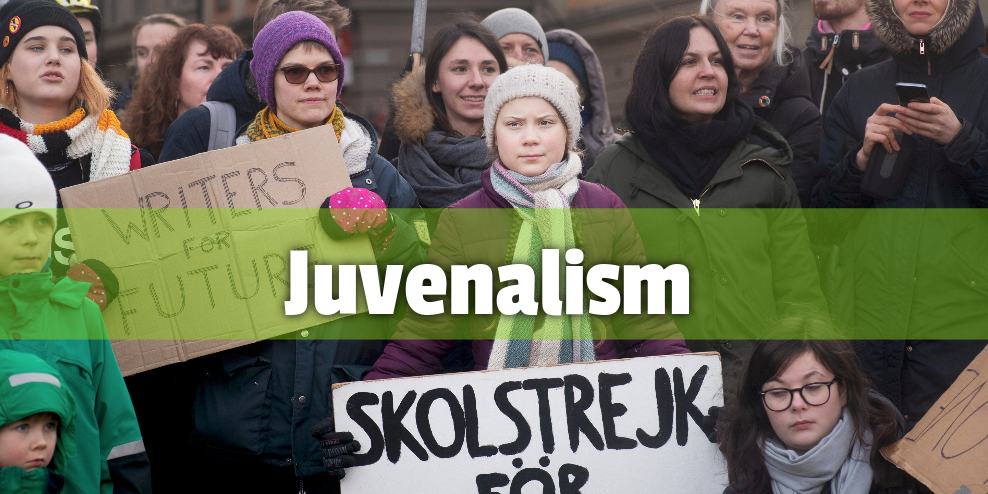
Juvenalism is an ideology which claims that, in a situation of crisis and historical "emergency", young people are the best suited to provide direction because their ideas are "new" and are neither marked nor constrained by the weight of immediate interests. Young people would thus speak "in the name of the future".
Historical origin of juvenalism
In 1896 the first nucleus of the Wandervogel appeared. At first they were an expression of the discontent of the German petty bourgeoisie in the midst of the expansion of imperialism. They revived German romanticism with a "back to nature" ideology and an ambiguous discourse of "emancipation" that served equally to give an anti-capitalist veneer and to criticize the family and educational models of the time.
The rejection of urban life and its "artificiality" was set against the "simplicity" of the hiking life, and the discovery of the landscape was equated with that of Nature. The Wandervogel soon introduced the mountaineering uniform -shorts, neckerchief, hobnailed boots, raincoat, hat or cap- and the love of the "campfire", creating a songbook for guitar and lute that is considered the beginning of German folk music.
As the movement developed, juvenalist ideas began to appear: young people, "clean" of the old world, are the ones called upon to bring "the new ideas" that are to emancipate society, overcoming the tensions, violence and crises of a world that is already old.
The combination of romantic essentialism, aesthetic anti-capitalism and exaltation of the landscape led "spontaneously" to the exaltation of leadership and nationalism. The Wandervogel soon became hierarchical and turned into a sort of unarmed, populist paramilitary groups.
Not only did they exclude women, they did not accept Jewish or foreign boys either. Little by little their naturalism turned paganizing, generating a Germanist mythology of its own.
Yes, it is what it looks like: the Nazi ideological pastiche was already there, in outline, before the first imperialist world war, shaping the imagination of thousands of petty-bourgeois boys.
So much so that in 1912 one of the most influential groups of the movement, "Vortrupp" (Vanguard), took up eugenics as its banner and began a discourse of "racial hygiene", banning tobacco -another later obsession of Hitler's-, beer, etc. When the Nazis came to power in 1933 and dissolved the independent youth organizations, most of the groups joined the Hitler Youth of their own free will.
Those that did not became "Edelweiss Pirates", roving bands of young people given to street fighting with their former Hitlerite comrades, who vented their rage without ever finding a political direction or serving as anything other than solvents of the struggles in the factories.
But these were not the only offshoots. After Baden-Powell used the model in the English-speaking world as a guide for creating future conquerors and soldiers for the British Empire, there was no irredentist European nationalism that did not create uniformed hiking youth groups to indoctrinate militants from puberty, if not from childhood. In the adoption of the form, drops of juvenalism always slipped in, which would end up distilling and merging into the cult of youth of Italian and Spanish fascism.
But despite the importance of those offshoots, the original juvenalism did not disappear either. In 1920, young Christians formed the first Bruderhof community, a movement that lives in community of goods and still survives today. Persecuted by the state under the Nazi government, they ended up in exile in Great Britain, Paraguay, the USA... and tried to join the Hutterites, old Anabaptist communalists from the time of the German peasant revolutions (16th century). A curious outcome -which also went wrong- of their original Christian juvenalism.
And something similar happened with the Jewish youth movements, also created in the image of the Wandervogel. They went from the "search for meaning" to the discovery and rejection of the kibbutz first, and from there to its ultranationalist "reinvention" later.
In fact, the discourse of Hashomer Hatzair, the most influential and numerous group among the youth movements that organized migrations to Palestine in the 1920s and 1930s, bordered on anti-Semitism: according to them, only the new youth, emancipated from their families and from the age-old culture of submission and oppression that Jewish culture was, could create a new moral and even physical type and lead the working masses of colonial Palestine.
By the mid-forties they were already fully integrated into Stalinism, which during the two previous decades had massacred the heart of the Bolshevik party. It was they who, via Czechoslovakia, armed the first Israeli army in 1948 with the rifles sent by Stalin.
Juvenalism and decadence
The dates and contexts of juvenalism, as well as its current revival, encouraged by the states as a propaganda pillar of the "Green Deal", show that juvenalism accompanies the decadence of the system in its development. Actually part of the "revolution in manners" that the petty bourgeoisie would drive forward from 1870 onwards, it can be considered one of the first ideological symptoms of decadence.
It is no coincidence that the few antecedents of juvenalism appeared in the final phases of both slavery and feudalism. The idea that those who symbolically represent the future -the young- are the only ones who can represent a better future in the present reveals the system's renunciation of any claim to represent and materialize the general interests of Humanity.
They are thus an evident symptom of the moral collapse characteristic of the phases of decadence of all modes of production. And for the same reason, these movements reveal a furiously reactionary character in denying the revolutionary class already present.