
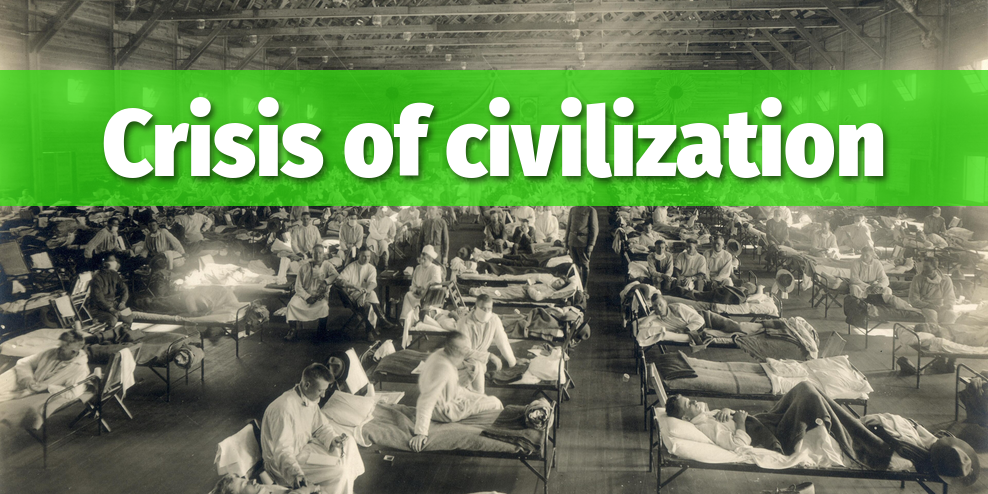
We call crisis of civilization the constant element in the decadence of a mode of production: the contradiction between systemic growth and human development. This contradiction operates permanently throughout the whole period, regardless of whether crises and wars are more or less virulent or lasting, and only disappears when the mode of production is overcome.
Growth vs development
While a mode of production is in its ascending phase, its growth and the development of human capacities go hand in hand. Under rising capitalism, in a system that is spreading across the world, improvements in labor productivity bring higher levels of consumption for the workers, shorter working days and a general development of social knowledge that is applied to improving the living conditions of society as a whole.
When the system enters decadence, growth and development part ways. The relations of production cease to be forms of development of the productive forces and become a brake on them, and growth, as the system itself defines it, that is, as the growth of capital (= accumulation of capital), begins to take place at the expense of human development.
Since the main productive force is the working class, and the system can no longer generate, in a sustained way, markets for everything it is able to produce, capital becomes a permanent machine for devaluing labor, and therefore the lives of the workers.
Every technical improvement that would allow more to be produced with less labor no longer brings better living conditions. It turns into unemployment, precariousness, exclusion and poverty instead of a greater satisfaction of universal human needs. Its development is bent to serve militarism and war, or to increase the totalitarian control of society. In culture and in the forms of interpersonal relations it ends up multiplying atomization and brutalization instead of serving the development of each individual.
The "objective conditions" imposed by the crisis of civilization
This contradiction between growth and development that defines the crisis of civilization is present in phases of recession and in phases of GDP growth alike, whether crises are acute and brief or become chronic or perennial. The crisis of civilization is not measured by the behavior of production in a particular country or by the state of world trade, but by the ever wider gap between what Humanity could and needs to do with its productive capacities and what capital does with them.
The deepening of this divorce between growth (of capital) and human development means not only that the overcoming of capitalism is immediately necessary, but that it is ever more urgent. In fact, in more and more fields, from war to climate change, from health to food, the development of the crisis of civilization tends to become an antagonism between capital and human life itself.
The dialectic of historical becoming does not put social revolution on the agenda because balances of payments and investments are out of joint, nor because unsold commodities pile up in fabulous quantities and throw millions upon millions of workers out of work. [...] No, no; what gives rise to the possibility and the necessity of communist revolution is much deeper than that; it is essential, not accidental. It lies in the very functioning of capitalist civilization, whatever the state of its business. Nor is it a matter of some particular aspect of the system, but of the whole of it, structures and superstructures, the economic, the political, the cultural in its many facets, the very customs and relations between human beings that are proper to it. All of it has become restrictive, inadequate, an obstacle to individual and collective flourishing.
Unemployment is one of the consequences of capitalism, but it is not what engenders the necessity of revolution; it is the conditions of work, consumption and life imposed on the world proletariat, wage labor, whatever the pay. Likewise, the so-called crisis of overproduction is or has been a pothole on the road of industrial development, but it is not its appearance, but the persistence of capitalist industrialism, that calls for the suppression of the system, for the instruments of production have acquired more than enough capacity to be freed from their mercantile pettiness. And so on.
In short: the wage form of labor is in absolute contradiction with the capacity of the instruments of labor. The separation between the one and the other has become unnecessary, and is therefore destructive, whatever the growth rates.
Manuel Fernández Grandizo (Munis), "The impossibility of capitalist development" (1972)